Smart Home Ideas for Everyday Life
Smart home ideas can make everyday life easier by helping you automate routine tasks, improve comfort, and use your home more efficiently. From smarter lighting and temperature control to convenient security and entertainment features, simple technology can make a noticeable difference without making your home complicated.
Living in the U.S. today means juggling packed schedules, family logistics, and an endless mental to-do list. The good news is that smart home technology has moved past being a collection of cool party tricks. Done right, it becomes an ecosystem that works quietly in the background — shaving off stress, saving you money, and giving you back a few precious minutes of your day.
And you don’t need to gut your walls, hire an electrician, or spend a fortune to get there. Most of the ideas below can be set up in an afternoon, several pay for themselves within a year through lower energy bills, and all of them solve a real, everyday annoyance rather than adding tech for tech’s sake.
Here are 15 smart home ideas worth considering if you want your house to finally work for you.
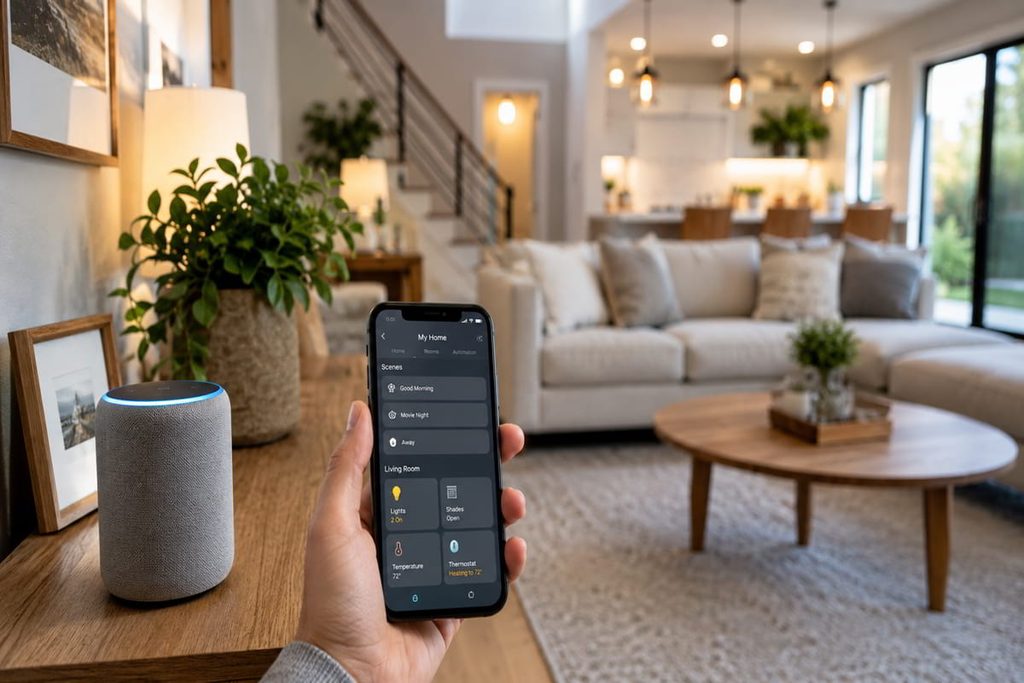
1. Start With a Smart Speaker Hub
Before you buy a single bulb, plug, or sensor, get a smart speaker or display — an Amazon Echo, Google Nest, or Apple HomePod. This becomes the “brain” that ties everything else together, so you’re controlling lights, locks, and thermostats with your voice instead of juggling five different apps. It also doubles as a house-wide intercom: a quick “broadcast” from the kitchen can replace shouting up the stairs that dinner’s ready.
2. Build a “Leaving Home” Routine
Stop doing the baseline lap around the house every morning to check lights and locks. With a single voice command “Hey Google, I’m leaving” or “Alexa, goodbye” you can trigger a chain reaction: indoor lights turn off, the thermostat drops to an eco-friendly setting, the security system arms, and the front door locks itself. One phrase replaces five separate habits you’re relying on your tired brain to remember.
3. Automate Your Morning Light
Waking up to a blaring alarm triggers a jolt of cortisol you really don’t need before coffee. Swap the noise for light: motorized smart blinds can be programmed to open gradually around 6:30 AM, and smart bulbs with circadian presets can shift from a soft sunrise glow in the morning to warm, blue-light-free amber tones by evening — helping you wake up gently and wind down naturally at night.

4. Let a Smart Thermostat Learn Your Schedule
A smart thermostat (Nest and Ecobee are the popular U.S. picks) learns your routine and adjusts automatically, so you’re not heating or cooling an empty house all day. The U.S. Department of Energy estimates households can save around 10% a year on heating and cooling with a properly used programmable thermostat — a smart one does that adjusting for you. Many models also track HVAC runtime and remind you when it’s time to change the air filter, which keeps the whole system running efficiently.
5. Add Smart Plugs to Ordinary Appliances
You don’t need to replace a perfectly good coffee maker, lamp, or curling iron to make it “smart.” A smart plug sits between the outlet and the device, letting you schedule or remotely control anything plugged into it — often for less than $15. It’s the cheapest, lowest-commitment way to try home automation, and a great fix for that nagging “did I leave it on?” anxiety.
6. Go Keyless with a Smart Lock
Smart locks let you in with a code, an app, or a fingerprint — no more digging for keys with your hands full. Many models support geofencing, so the door can unlock automatically as your phone approaches, or temporary codes you can issue to a dog walker, cleaner, or visiting family member and revoke the second they’re no longer needed. No more turning the car around to check if you locked up.
7. Install a Video Doorbell — and Secure Your Deliveries

A video doorbell (Ring and Google Nest are the big names) lets you see and speak to whoever’s at your door, whether you’re upstairs folding laundry or across town at work. It’s especially useful for tracking packages, which matters given how much of the country now shops online weekly. Pair it with smart garage access, and services like Amazon Key can grant a delivery driver one-time entry to leave packages safely inside your garage instead of out on the porch.
8. Schedule Your Robot Vacuum Around Your Life
A robot vacuum won’t replace a deep clean, but it will quietly keep floors tidy between them — and most current models map your home and steer around furniture, stairs, and pet bowls on their own. For the best experience, sync it with your phone’s location so it only runs once you’ve left the house, rather than interrupting a Zoom call or movie night with that unmistakable whirring.
9. Add Water Leak Sensors Where It Counts
Water damage is one of the most expensive things that can happen to a home, and it usually starts small — a slow drip under the sink, behind the washing machine, or near the water heater. A battery-powered smart water sensor, often around $20, sends an instant alert to your phone the moment it detects moisture, giving you a chance to stop a flood before it becomes a five-figure repair.
10. Upgrade to a Smart Smoke and CO Detector
Devices like Google Nest Protect send a phone alert to detect smoke or carbon monoxide, even when you’re not home, and some can tell you exactly which room the alarm is coming from — which matters when every second counts in an emergency.
11. Add Motion-Activated Night Lighting
Stubbing your toe on a 2 a.m. trip to the bathroom is a rough way to start the night. Small motion sensors along hallways or under bathroom vanities can trigger your smart lights at just 10% brightness after dark, lighting the way without jolting you fully awake.

12. Use Smart Shades to Manage Sunlight and Heat
Smart shades or motorized blinds do more than look impressive — they help regulate indoor temperature. Schedule them to open in the morning and close during the hottest part of the afternoon, and you’ll take some of the load off your air conditioning in summer while still letting warming sunlight in during cooler months.
13. Get a Weather-Smart Sprinkler Controller
Nobody wants to be the neighbor whose sprinklers are running full blast during a downpour. Smart sprinkler controllers check local weather data and automatically skip watering when rain is forecast for your zip code, adjusting run times by season. Since outdoor watering makes up a large share of summer household water use across much of the U.S., this is one of the easier upgrades to see reflected on your water bill.
14. Monitor Energy Use with Smart Plugs
Standby power — what devices quietly draw even when “off” adds up over a year. Energy-monitoring smart plugs and power strips can show you exactly which appliances are pulling the most electricity and cut power to entertainment centers or home office setups when they’re not in use, turning a vague sense that your bill is “too high” into an actual, fixable answer.
15. Tie It All Together with Scenes
The real magic of a smart home isn’t a single gadget — it’s connecting them into scenes built around how you live. A “Movie Night” scene might dim the lights, switch on TV backlighting, and close the curtains with one tap. A “Bedtime” scene could lock the doors, dim the lights, and drop the thermostat a few degrees. Start with one or two scenes rather than twenty automations at once — overcomplicating things early is the most common reason people abandon their smart home setup altogether.
How to Start Without Overspending
You don’t need to buy everything on this list at once. A better approach: notice the thing that annoys you most in your daily routine, and fix that first.
- Always forgetting to turn off lights? Start with smart bulbs.
- Constantly wondering if you locked the door? Get a smart lock.
- Tired of vacuuming? A robot vacuum is worth it.
- One room is always too hot? Look at smart shades or a zoned thermostat.
Before you buy, check compatibility — make sure new devices work with the smart-home platform and devices you already own, and confirm your Wi-Fi can comfortably handle the extra load. The whole point of a smart home is fewer apps and less friction, not more.
Final Thoughts
A smarter home doesn’t have to mean a more complicated one. The best setups aren’t the ones packed with the most devices — they’re the ones that quietly take care of the small stuff you’d otherwise have to remember yourself: a light that turns on when you need it, a thermostat that adjusts before you walk in, a sensor that catches a problem early.
Pick one everyday frustration from this list, solve it first, and let the rest of your smart home grow from there. That’s really what this technology should be about — less hassle, more comfort, and one less thing to worry about.


Pingback: Smart Home Automation for Busy Mornings: A 10-Minute Routine Hack
Pingback: 4 Simple Ways to Lower Electricity Bills at Home